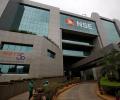
The National Stock Exchange of India's (NSE) mega Rs 22,569-crore initial public offering (IPO) was fully subscribed on the second day of bidding, driven by strong interest from qualified institutional buyers and non-institutional investors.

Indian benchmark indices, Sensex and Nifty, ended marginally lower after recovering from sharp intraday losses, driven by cooling crude oil prices and buying interest in HDFC Bank and IT sector stocks.

Indian benchmark indices, Sensex and Nifty, experienced a significant downturn, with Sensex tanking 778 points and Nifty closing at a five-month low, driven by surging crude oil prices, geopolitical tensions, and fears of further interest rate hikes by major central banks.
Indian benchmark equity indices, Sensex and Nifty, closed lower due to persistent geopolitical tensions in the Middle East and elevated crude oil prices, with investors remaining cautious ahead of fresh US sanctions on Iran.

At a valuation of around Rs 10 trillion, Tata Sons would rank among India's 10 largest listed companies and could qualify for inclusion in key indices such as the Nifty 50, Sensex and the Nifty 100.

Indian benchmark equity indices extended their losing streak for a fourth consecutive day, with the Sensex tumbling 417 points due to rising crude oil prices and a significant sell-off in IT stocks, impacting overall investor sentiment.

Indian stock markets, including the Sensex and Nifty, experienced their third consecutive day of declines, driven by a global selloff, escalating tensions in West Asia, and a subsequent rise in crude oil prices.

Indian benchmark indices, Sensex and Nifty, closed nearly flat on Thursday, influenced by the US Federal Reserve's interest rate hike and indications of further monetary tightening. Despite some intraday gains, caution prevailed, with foreign institutional investors continuing to offload equities. Meanwhile, the National Stock Exchange of India's (NSE) mega initial public offering opened for subscription, garnering 39 per cent subscription on its first day.
Indian benchmark indices, Sensex and Nifty, closed lower on Wednesday, reversing early gains due to profit-taking and weakness in sectors like IT, FMCG, and consumer durables, despite support from lower crude oil prices.

Foreign portfolio investors (FPIs) have injected Rs 30,919 crore into Indian equities in August, marking their second consecutive month of net buying. This follows a Rs 20,200 crore investment in July, indicating a potential reversal after four months of significant outflows, driven by improving corporate earnings, resilient economic activity, and a stable rupee.

Net inflows into smallcap funds surged 39 per cent M-o-M to a record Rs 7,768 crore, while midcap fund inflows rose marginally to Rs 6,192 crore.

Axis Bank has opened 50 new branches across India, while Abakkus Mutual Fund has surpassed Rs 10,000 crore in AUM. YES Bank launched a new credit card for women, and J&K Bank partnered with HDFC Life to enhance its insurance offerings, showcasing significant growth and strategic developments in the Indian financial sector.
Indian benchmark indices, Sensex and Nifty, closed flat on Friday, with elevated crude oil prices due to geopolitical uncertainties and a rebound in US Treasury yields making investors cautious and preventing a decisive market rally.
Indian benchmark equity indices, Sensex and Nifty, closed lower for multiple consecutive days, with the Nifty extending its losses to a seventh day, primarily due to elevated crude oil prices following the expiry of the US-Iran ceasefire without a diplomatic resolution.

DIIs invested $22.8 billion in Indian equities in Q2CY26.

Indian benchmark indices, Sensex and Nifty, saw gains in early trade, driven by a notable drop in crude oil prices and renewed buying interest from Foreign Institutional Investors (FIIs).
Indian benchmark indices Sensex and Nifty ended flat on Tuesday, with the Sensex dipping nearly 70 points, as investor sentiment turned cautious ahead of crucial global central bank policy meetings and a significant sell-off in Asian markets.

Indian benchmark stock indices, Sensex and Nifty, extended their winning streak to a fourth day, with Nifty surging 1.60 per cent, driven by a sharp decline in crude oil prices and renewed foreign fund inflows.

Foreign institutional investors have withdrawn nearly $40 billion from Indian equities in the last two years and, according to Bernstein analysts, have 'little reason' to invest for the long-term, though they may 'return to trade'. The brokerage highlights challenges such as struggling large-caps, disruption from new technologies, and difficulties accessing small- and mid-caps (SMIDs) at an institutional scale.

Indian benchmark indices, Sensex and Nifty, closed lower on Tuesday, with the Sensex declining 329.91 points to 74,529.08 and the Nifty dipping 85.30 points to 23,329, primarily dragged by underperformance in IT, financial, and capital goods stocks despite positive global market trends and easing crude oil prices.
Indian benchmark indices, Sensex and Nifty, closed significantly higher, driven by a combination of easing crude oil prices, fresh foreign fund inflows, and a positive trend observed in global equities.

Indian benchmark equity indices, Sensex and Nifty, rallied in early trade, driven by positive global market trends and easing crude oil prices, despite the US Federal Reserve's hawkish stance tempering overall sentiment. Track Sensex, Nifty on September 18.

Institutional portion subscribed 12.68 times; retail crosses quota.

Jindal Supreme (India) Ltd's initial public offering, a manufacturer of plastic piping solutions, was subscribed an astounding 181.07 times on its final day, reflecting robust investor demand across all categories.

Indian benchmark equity indices, Sensex and Nifty, closed mixed on Friday. While a drop in crude oil prices offered some relief, weakness in IT stocks and several Tata Group counters, including a significant dip in Tata Chemicals and ongoing boardroom issues at Tata Sons, limited a broader market recovery.
Indian benchmark indices Sensex and Nifty opened higher, extending gains from the previous session, driven by a rally in global markets and a slight cooling in crude oil prices. Optimism around a potential meeting between US and Iranian presidents also contributed to positive sentiment.Later both indices pared gains and were trading in red. Track Sensex, Nifty on September 22.

The National Stock Exchange of India's (NSE) mega Rs 22,569-crore initial public offering (IPO) was subscribed 43 per cent on its first day of bidding, making it India's second-largest public issue after Hyundai Motor India's Rs 27,870-crore IPO in 2024.

Shares will be allocated across different institutional investors, including domestic mutual funds, other domestic institutions and FPIs.

Indian benchmark indices Sensex and Nifty extended their losses for the fourth consecutive session, with the Sensex declining 363.66 points and the Nifty dipping 126.65 points, primarily due to a sharp jump in Brent crude oil prices to USD 98.32 per barrel amid escalating tensions in West Asia.
Indian equity benchmark indices Sensex and Nifty rebounded sharply in early trade, with the Sensex jumping over 530 points, tracking a broad-based rally in Asian markets after four consecutive days of decline.
Indian benchmark indices Sensex and Nifty rebounded on Wednesday, driven by value buying in banking stocks and select heavyweight counters, with the Sensex climbing 332.63 points and the Nifty ending above 23,200.

Indian stock market investors are closely monitoring crude oil prices, geopolitical developments in West Asia, and the implications of the US Sanctioning Russia and Iran Act, which could impose tariffs on countries, including India, that purchase Russian crude.

The initial public offering (IPO) of auto components maker Hero Motors Ltd was fully subscribed on its first day of bidding, receiving bids for 1.38 times the shares on offer, with strong interest from retail investors.
Indian benchmark indices, Sensex and Nifty, saw early gains driven by strong buying in IT stocks like HCL Tech, Tech Mahindra, TCS, and Infosys, alongside a significant boost from HDFC Bank.
The National Stock Exchange of India's (NSE) mega Rs 22,569-crore initial public offering (IPO) opened for subscription, receiving 9 per cent bids on its first day, with strong participation from anchor investors.
Indian benchmark indices, Sensex and Nifty, saw an early rebound after significant losses, driven by value buying, though elevated oil prices and anticipation of the US Federal Reserve's policy decision tempered gains. Track Sensex, Nifty on September 16.

Indian benchmark indices, Sensex and Nifty, traded marginally higher in early trade despite the US Federal Reserve's recent rate hike and indications of further tightening, with the National Stock Exchange's much-anticipated Rs 22,569-crore IPO also opening for subscription.
The National Stock Exchange of India's initial public offering (IPO) was subscribed 5.69 times, with qualified institutional buyers (QIBs) showing the strongest demand, as the Rs 22,561-crore issue moves towards allotment and a planned listing on the BSE.
Indian benchmark equity indices closed higher on Thursday, with the Sensex gaining 273.55 points to 77,928.15 and the Nifty rising 66.95 points to 24,317.15, driven by bargain hunting and short-covering in IT and auto sectors.
Indian benchmark equity indices, Sensex and Nifty, rebounded in early trade after a three-day slide, driven by strong buying in blue-chip bank stocks and a firm trend in global markets, supported by easing US bond yields and record foreign-currency deposit inflows.
